The elbow nudge at 2 a.m. may feel small in the moment. After weeks of interrupted sleep, though, it can turn into exhaustion, short tempers, anxiety about bedtime, and even nights apart. The best snoring solutions for couples do more than make a room quieter. They help both people feel considered, rested, and comfortable sharing a bed again.
Snoring is common, and it is not a personal failure. But neither partner should have to simply accept poor sleep. A practical plan starts with understanding what may be causing the noise, choosing an approach you can use consistently, and knowing when snoring needs medical attention.
Why Snoring Can Feel So Personal
For the person who snores, there can be dry mouth, groggy mornings, and the uncomfortable realization that a partner is losing sleep. For the bed partner, there is often a difficult choice: lie awake listening, move to the couch, or wake someone they love yet again.
That dynamic can make couples avoid the subject until frustration boils over. A better approach is to treat snoring as a shared sleep issue, not one person's bad habit. Use neutral language: “We both need better rest. What can we try for the next two weeks?” That turns a nightly conflict into a manageable experiment.
What Causes the Sound of Snoring?
Snoring commonly happens when airflow moves past relaxed tissues in the upper airway, causing them to vibrate. That is why the sound can change from one night to the next. Sleeping on the back, alcohol close to bedtime, nasal congestion, fatigue, and individual anatomy can all play a role.
For many people with non-apneic snoring, the source is not only the nose. It may involve the mouth and back of the throat, where upper-airway tissues relax during sleep. This distinction matters because a solution that only pulls on the outside of the nose may not address what is happening farther back.
Snoring Solutions for Couples: Start With What You Can Sustain
The right choice depends on the likely cause of the snoring and, just as importantly, what the snorer is willing to use night after night. A product that ends up in a drawer after three uncomfortable attempts is not a real solution for either person.
Make a few low-pressure bedtime adjustments
If snoring is occasional, begin with simple changes. Side sleeping can help some people, particularly if they tend to snore more loudly on their backs. Limiting alcohol near bedtime may also help, since alcohol can further relax upper-airway tissues. Addressing temporary congestion and keeping a consistent sleep schedule can be worthwhile as well.
These steps are useful, but they are not always enough for habitual snoring. They also require patience. One better night does not prove a permanent fix, and one loud night does not mean a plan has failed.
Be honest about external devices
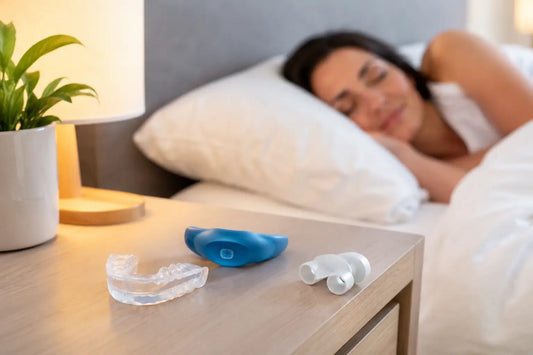
Mouthguards, chin straps, mouth tape, nasal strips, and nasal clips are familiar options. Some people find a device helpful, especially when a specific issue such as nasal congestion is involved. Others find these approaches restrictive, awkward, or hard to maintain.
That trade-off is especially relevant for couples. A bed partner may be eager for quick relief, while the snorer may dread taping their mouth, wearing a strap, or packing an embarrassing sleep device for a trip. Consent and comfort count. A solution should not feel like a punishment for either person.
Consider a device-free oral approach
For adults seeking relief from non-apneic snoring without overnight equipment, an oral spray or chewable tablet can be a practical alternative. Rather than holding, taping, pulling, or repositioning the nose, mouth, or jaw, this type of approach is used before sleep and is designed to work from inside the mouth and at the back of the throat, where snoring commonly begins.
SnoreStop offers doctor-formulated oral sprays and chewable tablets with natural-source active ingredients from plant, mineral, and protein sources. Its products are FDA-regulated OTC medicines, made in the United States according to Good Manufacturing Practices, and prepared according to HPUS standards. For couples who have already tried external devices, the appeal is straightforward: no bulky equipment to wear overnight and no complicated bedtime routine.
Published research also matters when you are deciding what is worth trying. In an independent, randomized, double-blind, placebo-controlled clinical study published in Sleep and Breathing, 79.5% of participants taking the studied SnoreStop Chewable Tablet formula reported positive results. No side effects or drug interactions were reported in that study. Those findings apply specifically to the studied Chewable Tablet formula, not automatically to every snoring remedy or every cause of snoring.
Create a Plan Both Partners Can Live With
A shared plan works best when it has a clear trial period and no scorekeeping. Pick one or two changes, use them consistently for a couple of weeks, and check in during the day rather than in the middle of the night.
Keep the conversation specific. Did the bed partner wake up fewer times? Did the snorer feel more rested? Was the routine easy enough to repeat while traveling or after a late night? A simple note on the phone can reveal patterns that memory misses.
It also helps to agree on a kind overnight backup plan. If one person is awake and overwhelmed, moving temporarily to a guest room or using earplugs may protect sleep without making it a relationship statement. Separate sleep on an occasional rough night is not the same as giving up on sleeping together.
When Snoring Needs a Medical Conversation
Not every snore is harmless. SnoreStop is intended for non-apneic snoring and is not a treatment for sleep apnea. If the snorer has pauses in breathing, choking or gasping during sleep, pronounced daytime sleepiness, morning headaches, or high blood pressure, seek medical evaluation rather than trying to manage the problem solely at home.
A partner often notices these signs first, so it is reasonable to bring them up with care. “I noticed you seem to stop breathing sometimes, and I am worried about you” lands very differently than “Your snoring is unbearable.” A clinician can help determine whether sleep apnea or another condition may be involved.
Protect Connection Along With Sleep
Couples often focus on silence as the only goal. Better rest is the goal, but so are dignity and connection. The snorer deserves an option that does not feel embarrassing or burdensome. The bed partner deserves sleep without nightly resentment or endless elbow nudges.
Choose a next step that feels easy enough to begin tonight, then give it a fair, consistent try. A calmer bedtime routine can make room for something both people miss when sleep has been difficult: waking up beside each other feeling more like a team.